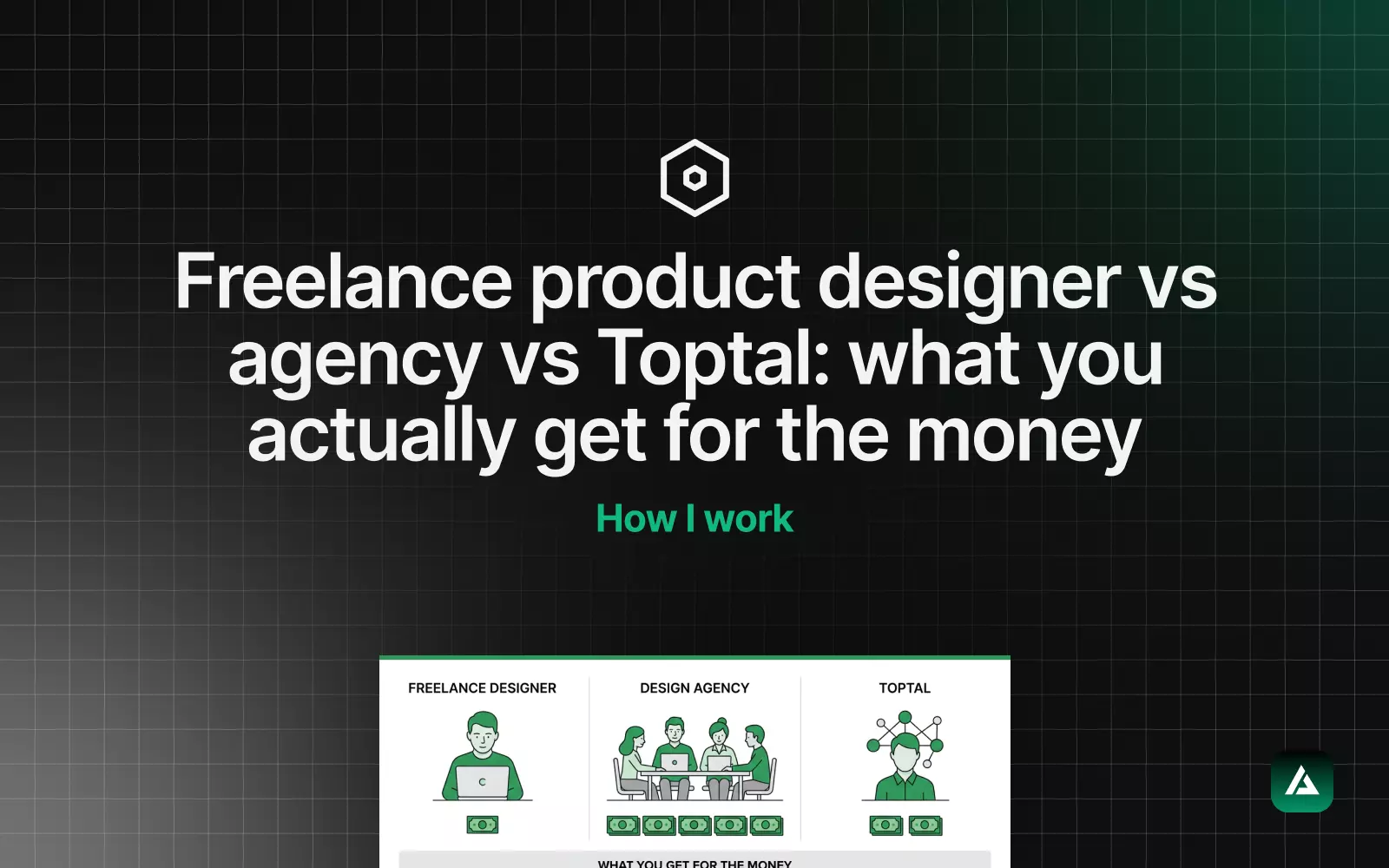
Same brief, three suppliers, three very different products. Founders ask me this comparison on almost every first call, usually as "why not just use Toptal?". Here is what you are buying with each, without the pitch, including the cases where I would not be the right choice.
What you are actually buying
An agency sells a team and a process. A marketplace like Toptal, Contra or Upwork sells matching: access to many freelancers, a vetting badge, and an admin layer. A senior freelancer sells one person's judgement and hands. Everything else, cost, speed and risk, follows from that.
Who does the work
At an agency, a senior designer or creative director runs the pitch and the kickoff. Production is done by mid-level designers, reviewed by the senior. That is not a scam, it is how agencies make money, but it means the quality you saw in the pitch is the ceiling, not the average. On a marketplace, the person who does the work is the person you were matched with, and the match is the whole bet. With a freelancer, the person you met is the person on your Figma file at 9am, and you can judge them in one call.
What it costs
| Senior freelancer | Agency | Toptal or marketplace | |
|---|---|---|---|
| Typical monthly cost | $4,000 to $8,000 | $15,000 to $40,000 | $10,000 to $20,000 at $80 to $150 an hour |
| What the money pays for | Design | Design, project management, office, pitch work for the next client | Design plus a platform margin of roughly 20 to 40 percent |
| Minimum commitment | One month, often a one-time kickstart | Usually a three-month retainer | Hourly or weekly |
The agency is not overpriced, it is paying for things you may not need. If you need them, pay for them.
Speed to first screens
Agency: three to six weeks, after discovery, a proposal and a kickoff workshop. Marketplace: days once matched, but matching itself can take a week or two and a false start costs you another. Freelancer: I send a one-page brief the same day as the call and the first screens within a week, because there is no one to hand off to.
Risk, and how each handles it
- Agency: continuity. People rotate off your account. Protect yourself by naming the designer in the contract.
- Marketplace: quality variance. Protect yourself by buying a small paid task first and by owning the files from day one.
- Freelancer: one person can get sick or busy. Protect yourself the same way I protect my clients: a token-based design system and clean Figma files in your workspace, so anyone can continue the work, and a clear answer to "what happens if you are away a week".
When each is the right call
- Agency when you need brand, website, launch video and product at the same time, with a budget above $20,000 a month, and you want one invoice.
- Marketplace when the task is small and well defined: a landing page, a batch of icons, overflow for an in-house team.
- Senior freelancer when the work is the product itself: flows, screens, a design system your developers build on, and someone who will argue with you about the onboarding. That is the work I do, and the freelance product designer for SaaS startups page shows the three ways to engage.
When I am the wrong choice
You need three disciplines in parallel this month, you need forty screens in two weeks, or you need someone in your office. Hire an agency for the first, a small team for the second, and a local designer for the third. I will say so on the call.
Questions to ask any of the three
- Who exactly will be in my Figma file, and can I talk to them before signing?
- Do I own the files and the design system from day one?
- What did you ship for a company like mine in the last six months?
- What is the smallest thing I can buy first?
If the answers are a name, yes, two live products and a one-week kickstart, you have found a good one, whichever model they work in. If you want to go deeper on the hiring side, read how to hire a product designer for your SaaS startup.