Most teams bring in a design system consultant either too early or too late. Too early is a five-person startup that wants a component library before it has product-market fit. Too late is forty engineers, five versions of the same button and a rebrand due next quarter. Here is how I tell where a team sits on a first call, and what to do in each case.
What a design system consultant actually does
Not just a UI kit. A UI kit is a set of nice components in a Figma file. A design system is the agreement behind them: which colours, spacing and type exist, what they are called, how they map to code, and who is allowed to change them. A consultant's job is to set that agreement up and leave it in a state your team can run.
In practice that means five pieces of work:
- Audit and inventory. Collect every button, input, card and colour that exists today and find the duplicates.
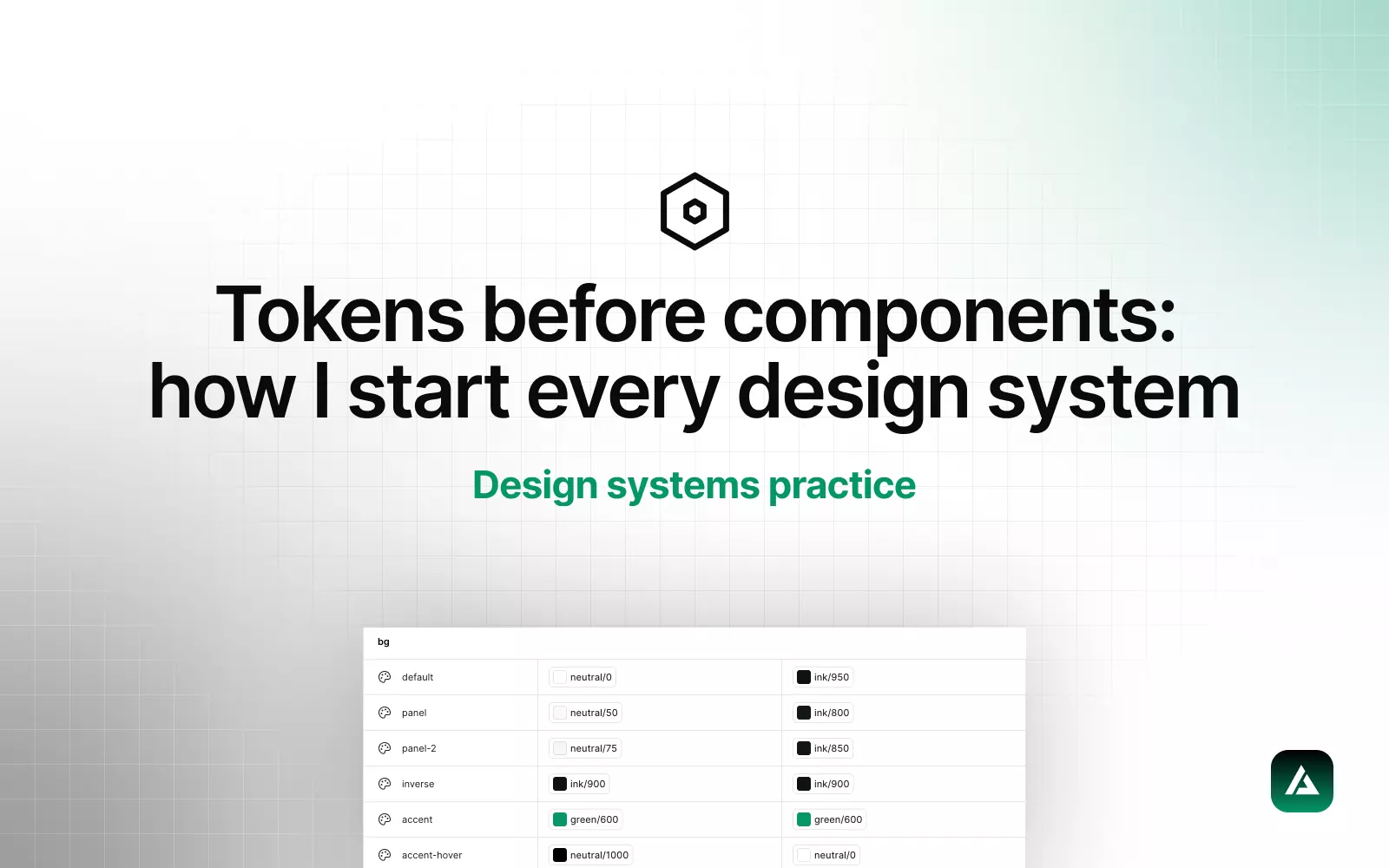
- Token architecture. Define the colour, spacing, radius and type tokens, with names that map one to one onto your code. I always start here, and I explain why in tokens before components.
- Components. Build the core components with their variants and states, in light and dark if you need both.
- Documentation. Short usage rules where people already look: in Figma, Storybook or Notion.
- Handover and governance. Who owns the system, how changes get proposed, and how engineers keep code and Figma in step.
Seven signs it is time
- The same component exists several times in code. Search your repo for button components. If you find more than two, you are paying for each of them in maintenance.
- Visual inconsistency is a regular QA category. Wrong grey, wrong spacing, wrong radius, every sprint.
- New screens start from scratch. Designers detach instances or copy from old files because the library does not have what they need.
- Engineers guess. They copy spacing and colours from the nearest screen because there is nothing to look up.
- Themes are coming. Dark mode, a rebrand or white-labelling for enterprise clients. Themes are where products without tokens break.
- The design team is growing. You have just hired a second or third designer, or you are about to.
- AI tools generate off-brand UI. Cursor and Claude Code build screens fast, but without tokens and a rules file they invent their own colours and spacing. A system is what keeps generated UI consistent.
Two or three of these and a consultant will pay for themselves. Five or more and the cost of waiting is already showing up in your velocity.
Three signs it is too early
- You have not found product-market fit. The UI is going to change wholesale. Start from an existing kit such as shadcn/ui, set up a small token file, and spend the money on the product.
- One designer, one product. A shared Figma library that the designer maintains is enough. You do not need governance for one person.
- Nobody will own it. A system without an owner decays within months. If nobody on the team will look after it after the consultant leaves, fix that first.
Consultant, full-time hire or do it yourself
| When it fits | The risk | |
|---|---|---|
| Do it yourself with a starter kit | Pre product-market fit, a small team, one product | Debt you pay later, but cheap now |
| Design system consultant | You need a v1, or a rescue of an existing system, in four to eight weeks, and you have someone to hand it to | It decays if nobody owns it afterwards |
| Consultant, then a light retainer | You want v1 fast and senior oversight while it settles | Only works if the retainer has a clear scope |
| Full-time design system designer | Twenty or more engineers, several products, constant change | Hard to hire, and underused in the first months |
What a good engagement looks like
A foundational system takes four to eight weeks, delivered in phases so your team can use the first parts while the rest is built.
- Weeks one and two: audit, inventory and the token layer. Your engineers can adopt the tokens straight away, before any component exists.
- Weeks three to six: core components, from inputs and buttons up to tables, modals and navigation, with states and variants.
- Weeks six to eight: documentation, the code handover, and the governance rules.
The result should be measurable. On ZoApps, a component system built this way covered the large majority of UI patterns, so engineers shipped features without waiting on design for every new screen.
How to judge a design system consultant
- Ask to see token naming, not just a components page. Components are easy to make look good. Naming is where the thinking shows.
- Ask how their Figma variables map to code. The answer should be specific: CSS variables, a Tailwind config, a tokens JSON file.
- Ask what they would leave out of v1. A good consultant cuts scope. A weak one sells you a hundred components.
- Ask who owns the system after they leave. If they have no answer, the system will not last.
- Ask to see a system that has been in use for a year. A system that has survived real use is worth more than a launch screenshot, and a consultant who can tell you what their first version got wrong has learned from it. I wrote mine up in how I built GliaKit.
Questions founders ask
How long does it take to build a design system?
A foundational system with tokens, core components and documentation takes four to eight weeks. A full system for several products takes longer, but should still ship in phases rather than all at once.
Do I need a design system for an MVP?
Usually not a full one. Use an existing component kit and define your tokens from day one, so that when you do build a system you are extending something rather than replacing it.
Can a consultant fix our existing system instead of starting over?
Yes, and that is usually the better route. An audit shows which parts are worth keeping, and most rescues keep the components and rebuild the token layer underneath them.
Figma only, or code too?
Both should move together. The consultant may only build the Figma side, but they should work with your engineers until the tokens and components exist in code with the same names.
If you recognise three or more of the signs above, my design system consultant service covers the audit, tokens, components and handover in four to eight weeks.