Your app works, mostly. Then real people sign up, something goes wrong, and you search for someone to fix your Lovable app. You find hundreds of marketplace gigs and, in Lovable's own partner directory, 837 certified partners as I write this. Nearly all of them are builders. That is the right hire for some problems and an expensive detour for others. This post sorts the symptoms into two kinds, gives the order that wastes the least money, and lists what to ask before you hand anyone the keys.
Two kinds of broken
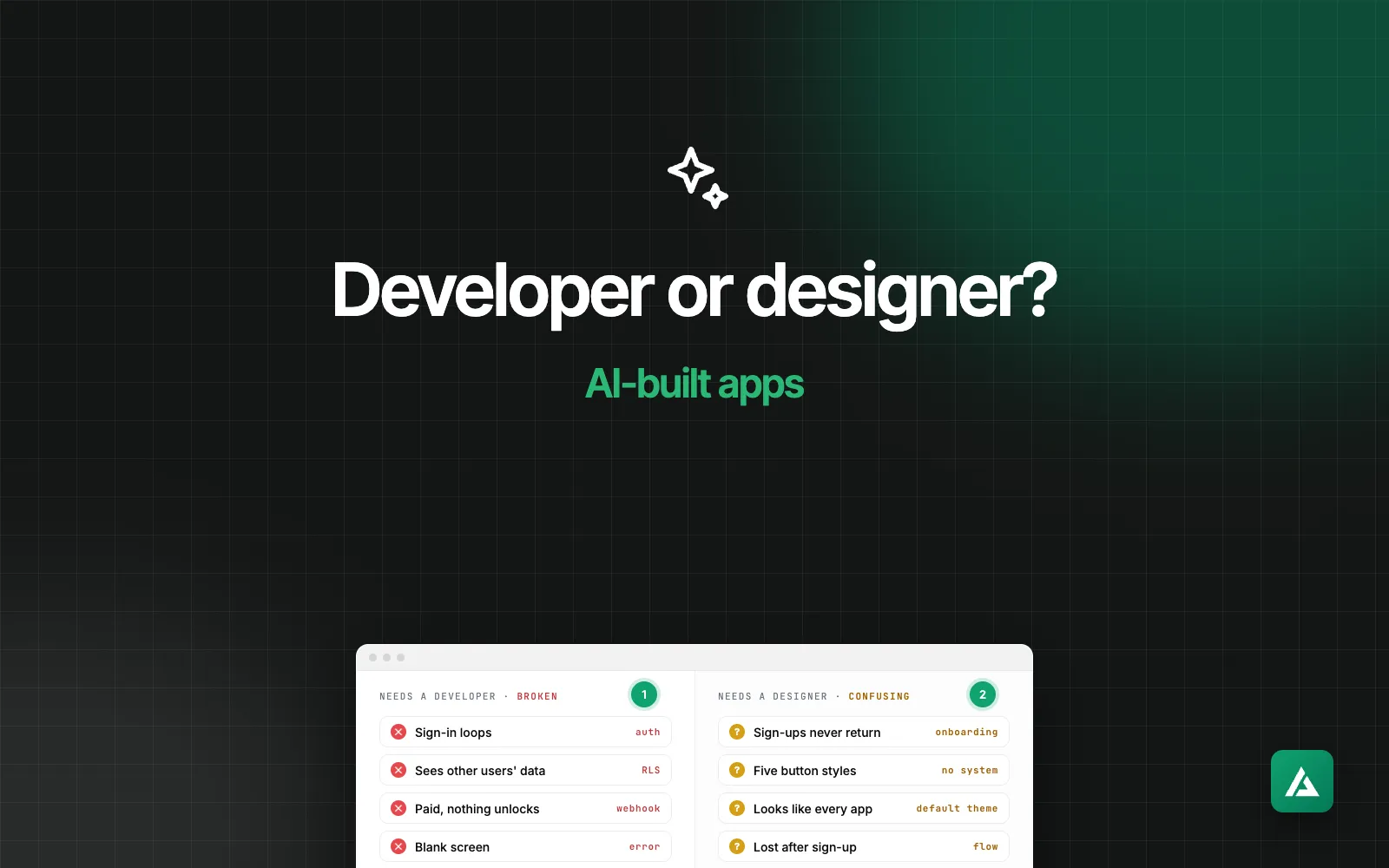
A developer fixes what the app does. A designer fixes what people understand and trust. Most founders can tell which one they need from the symptoms alone.
| Symptom | Usually means | Who fixes it |
|---|---|---|
| Users get logged out, or sign-in loops | Session or auth configuration | Developer |
| A user can see another user's data | Missing database permissions, such as row-level security | Developer, today |
| Payments go through but nothing unlocks | A webhook or subscription sync | Developer |
| A screen goes blank or shows a raw error | An unhandled error in the code | Developer |
| Pages take seconds to load | Queries, images or bundle size | Developer |
| People sign up and never come back | No designed path to the first useful moment | Designer |
| Support emails ask where to find things | Navigation, labels and structure | Designer |
| Every screen looks a little different | No design system, so each prompt invents its own UI | Designer |
| It looks like every other AI-built app | The default theme and generic copy | Designer |
| Forms confuse people | Validation is code, the messages and layout are design | Both |
If your list has both kinds, do not expect one person to do the other job by default. A developer will make the onboarding work exactly as it was generated. A designer will make a clear, beautiful screen that still shows other people's data.
Check this first, whatever you hire
Before anyone touches the design, find out whether the app is safe. In 2025 a vulnerability was published for Lovable-generated apps whose database tables had no row-level security, which let people who were not signed in read or change data. I covered it in the pre-launch UX checklist. If your app stores anything about its users, have a developer check the database permissions and the keys in the client code before you spend money on screens. For someone who knows Supabase it is a short job, and it is the one fix that cannot wait.
When you need a developer
Hire a developer when the app does the wrong thing: errors, broken sign-in, payments, slow pages, emails that never arrive, data in the wrong place. For an app built with Lovable, look for someone who already works in its stack, usually React, Tailwind and Supabase, so they fix the cause instead of rewriting around it.
Lovable's partner directory is a good place to start, and you can filter it by service, industry and country. Lovable certifies its experts on projects they have already shipped, plus courses on security, client delivery and SEO. It also says partner details are self-reported, so check their work as you would anyone else's. Marketplaces such as Fiverr and Upwork suit one narrow fix with a clear before and after: one bug, one integration, one deploy.
Ask three things on the first call:
- Will you work in my repository and keep my stack? Moving you to a new framework is a rebuild with a different name.
- Can I keep using Lovable after you change the code? Yes, if they work through GitHub. Lovable's GitHub sync is two-way: commits pushed to the synced branch, usually
main, come back into the editor. If the two sides diverge, Lovable pushes its own changes to a separatelovable-syncbranch instead, so agree who works when. - What will you not touch? A good developer names the edges of the job before you ask.
The red flag is a rebuild quoted on the first call, before anyone has read the code. Most AI-built apps have sound logic under a messy interface.
When you need a designer
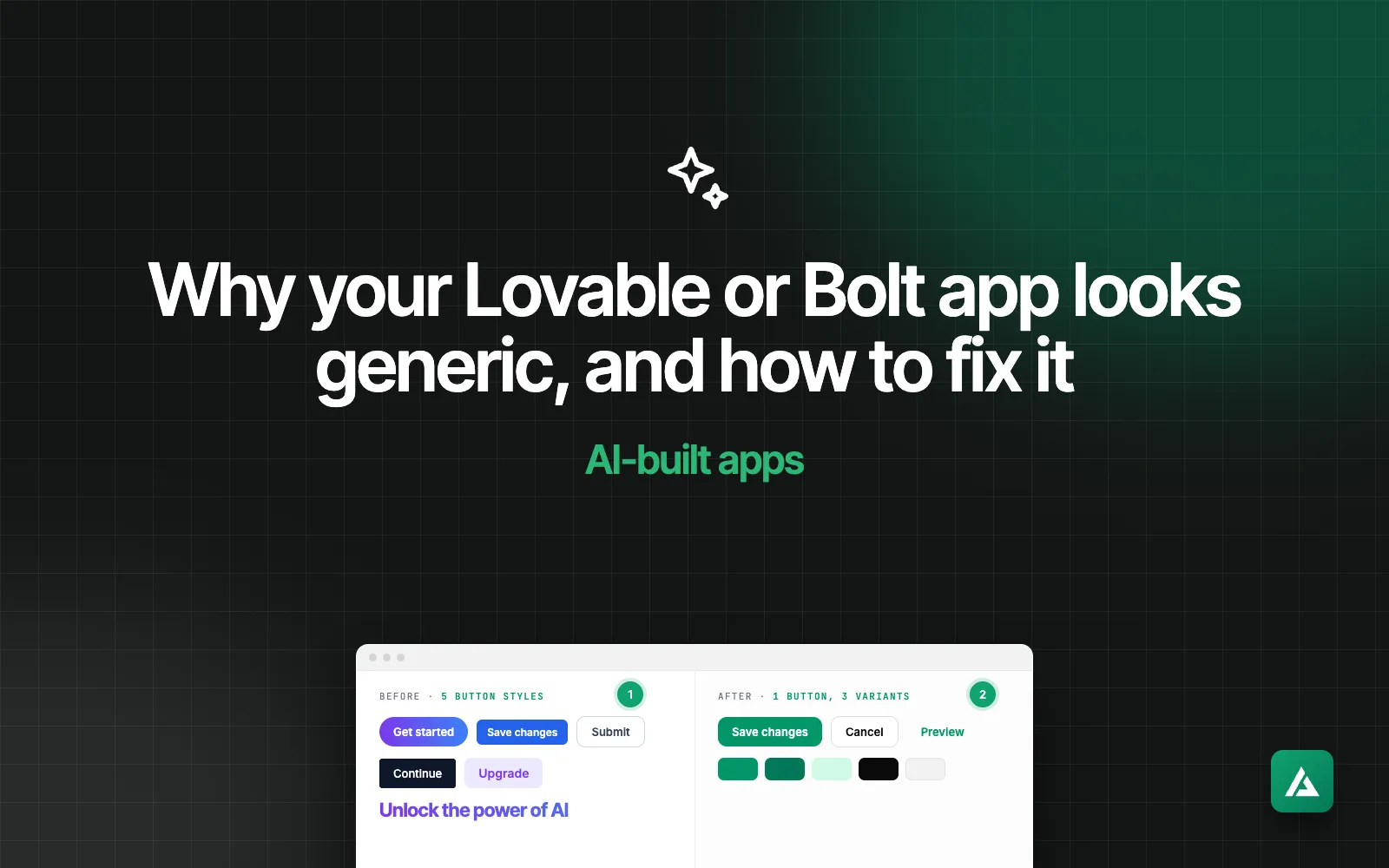
Hire a designer when the app works but people do not get it, do not trust it or do not come back. That is the gap AI builders leave most often: every prompt produces a working screen, and nobody designs the path between them. I wrote about the visible side of it in why your Lovable or Bolt app looks generic.
For an AI-built app, the useful kind of designer does three things a pure UI designer may not:
- Starts with the flows, not a new logo. Where do people drop between sign-up and the first useful moment, and why?
- Sets a small design system your code can use. Tokens and core components in the code, not only a Figma file nobody opens again.
- Writes the rules your AI tools follow. Without them, the next fifty prompts drift back to the defaults and undo the work.
Ask whether they can work in your code or only in Figma. If your app is React and Tailwind, a designer who can ship the interface changes saves you a handoff. If they only deliver Figma, budget for someone to build it, or prompt your builder with the exact tokens and components they hand over.
The red flag here is a portfolio of beautiful screens and no shipped products, or a redesign that throws away your working components. You want the same app, consistent and clear, not a different app.
What it costs
Marketplace developers sell small fixed packages, which are good value for one bug and poor value for a system. Agencies quote projects. A senior freelance product designer charges $90 to $150 an hour in the US and $60 to $110 in Western and Central Europe, and the full ranges are in freelance product designer rates in 2026.
Hourly is fine for a bug. For a cleanup, ask for a fixed scope after an audit, so you know exactly which flows, screens and deliverables you are paying for. If two quotes are far apart, they usually describe different jobs. Put both against the same list of symptoms and the difference shows.
The order that wastes the least money
- Safety. Database permissions, keys and sign-in. A developer, and it cannot wait.
- Function. Anything that errors, goes blank or loses data. A developer.
- Experience. Onboarding, the core flow and consistency, on a small design system. A designer, ideally one who can work in your code.
- Rules. The tokens, components and states written into your project knowledge or rules file, so the fixes survive the next prompt.
If your app has no bugs and people still leave, start at step three. That is more common than it sounds: the builder made every screen work, and nobody made the whole thing make sense.
How to brief either one
A good brief saves most of the first week. Send:
- The live link and a test account. Not your own login. Invite people as collaborators instead of sharing passwords.
- The code on GitHub. Lovable and v0 can both connect a project to a repository, and v0 pushes its changes to a working branch and merges them through a pull request. Connect it before the work starts. If your builder cannot, download the code and put it in a repository.
- Your top three problems. Each with a screenshot or a short screen recording, and what should happen instead.
- What users do in the first ten minutes. From analytics if you have them, from three watched sign-ups if you do not.
- What must not change. Your domain, your data, your prices, and any flow that already converts.
When the work is done, rotate any keys you shared and remove access nobody needs.
Questions founders ask
Can a Lovable expert also fix the design?
Some can. Lovable certifies experts on building, security, client delivery and SEO, so ask to see apps they redesigned, not only apps they built.
Will I still be able to use Lovable after someone edits the code?
Yes, if they work through GitHub. The sync is two-way on one branch, usually main. Agree who works when, so you are not prompting in Lovable while they push changes to the same files.
Should I rebuild the app instead?
Usually not. The data model, routes and business logic are often worth keeping, and the interface can be replaced screen by screen on top of a design system.
Do I need both a developer and a designer?
Only if your symptoms fall on both sides of the table. If they do, fix safety and function first, then design, and keep both people working in the same repository.
If your list lands on the design side, my AI-built app cleanup covers the audit, the core flows, the design system and the rules file, in a fixed scope after a free review. If it lands on the developer side, the three questions above will help you hire well.